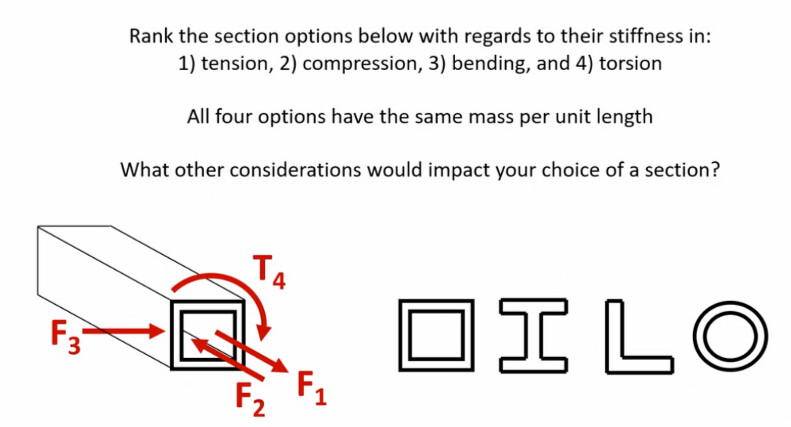
Rank the section options below with regards to their stiffness in: 1) tension, 2) compression, 3) bending, and 4) torsion.
All four options have same mass per unit length.
Square tube, I-beam, L-beam, Circular tube
Rank the section options below with regards to their stiffness in: 1) tension, 2) compression, 3) bending, and 4) torsion.
All four options have same mass per unit length.
Square tube, I-beam, L-beam, Circular tube
In tension and compression, the stiffness will be dependent on:
A*E
As in these scenarios, the elongation is given by the formula:
Elongation = (Load * Length)/ (Area * Young’s Modulus of Elasticity)
So increasing the A*E will decrease the overall elongation. Thus you have increased the stiffness.
In Bending, Flexural Rigidity plays an important role as deflection is inversely proportional to (Young’s Modulus times Area moment of inertia)
So increasing the Area moment of inertia will decrease the deflection thereby increasing the stiffness.
Let’s talk about Torsion now, in torsion Torsional Rigidity plays an important role.
The twist angle is given by the formula,
Theta = (Torsion * Length)/ (Modulus of Rigidity * Polar Moment of Inertia)
Now if you want to reduce the twisting, i.e. reduce the twist angle, you would have to increase Modulus of Rigidity * Polar Moment of Inertia, which is called the Torsional Rigidity.
I hope this helps!
I’ll leave the rest for you to figure out!